

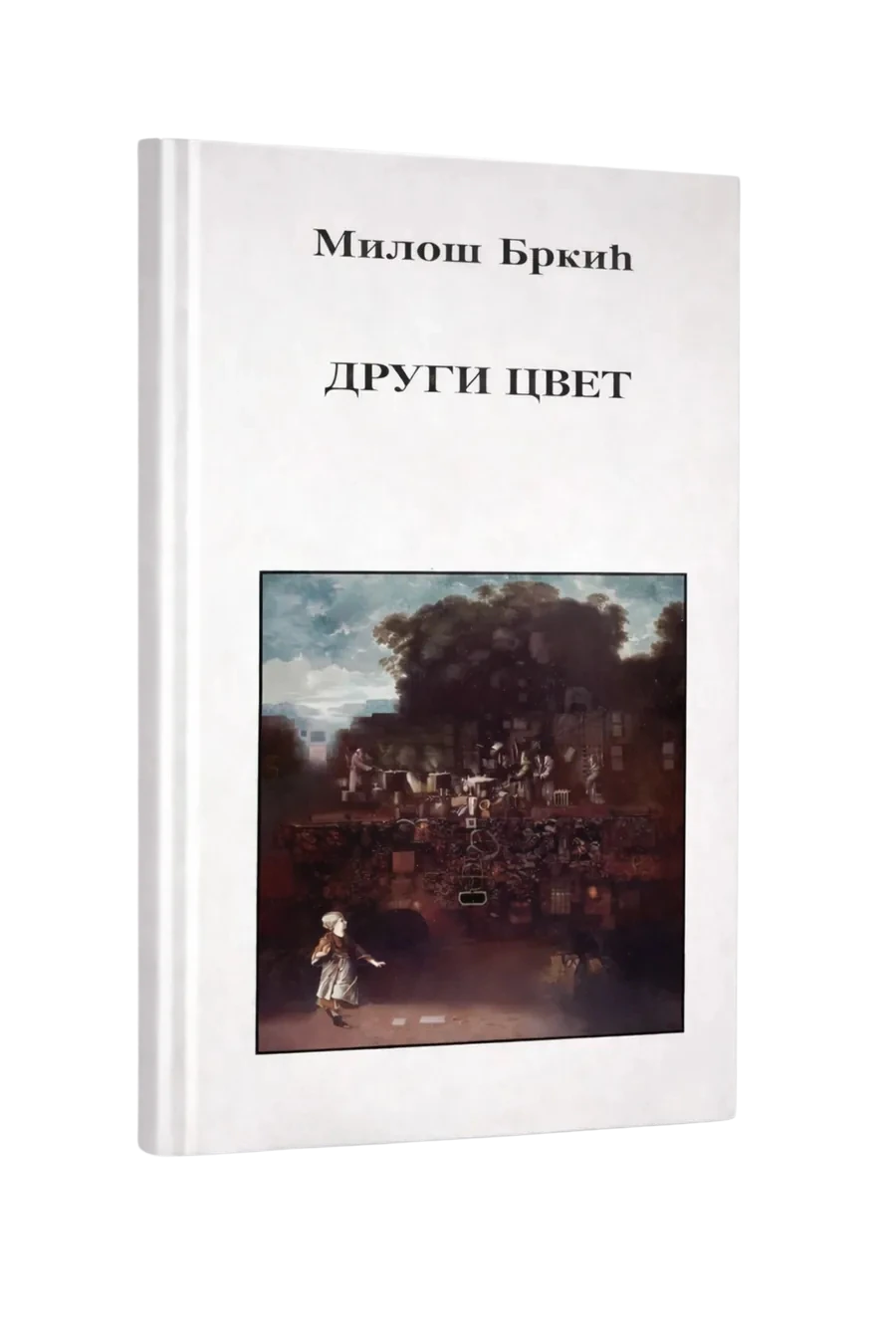
The Other Flower
- AuthorMiloš Brkić
- GenrePoetry
- Year of publication2014
- Pages80
- PublisherCenter for Culture Mladenovac – “Šumadijske metafore”
- ISBN978-86-85201-57-8
About the Book
The Other Flower is a poetry collection by Miloš Brkić, originally published in Serbian in 2014 under the title Drugi cvet. The book belongs to the earlier period of his poetic work, carrying the emotional directness, intimacy, and lyrical tension that would continue to shape his later collections.
Its poems move through themes of love, memory, longing, fragility, and inner transformation. The title itself suggests another blooming — a second opening of the self, of feeling, and of the poetic voice.
Read today, The Other Flower stands as one of the important steps in the development of Brkić’s poetic world: personal, melancholic, and turned toward the quiet spaces where emotion becomes language.
From the Review
It has been a long time since I had the opportunity to write about a poetry collection containing so few poems. In Brkić’s Drugi cvet, there are seven in total. The first cycle, entitled “Krug”, the second, “Mimohod”, and the final, fourth cycle, “Okamenjeni snovi”, each contain two poems. Only the third cycle, “Jurim vetrenjače”, stops at a single poem — though one composed of fourteen parts — entitled “Slutim”. Seven is, we must mention, a number charged with symbolic meaning. It is the number of the universe and the macrocosm. It signifies totality, perfection, safety, abundance, virginity. It is the number of the Great Mother. There are seven days in a week, seven notes in the musical scale, seven wonders of the world, seven ages of man… If the titles of the cycles are arranged in sequence, they form a lyrical “story” that stands at the heart of the entire collection: I circle through the procession, chasing windmills of petrified dreams.
This collection is a poetic procession along a circular path, with a constant return to what has already been sung, as if to let it descend even deeper into dreams that have become completely intertwined with waking life — removing the already fluid boundary which, when true poets are concerned, trembles as it tries to separate reality from what has been imagined and dreamed.
Brkić’s collection compels us to remember certain things we had almost completely forgotten when thinking and writing about poetry books created in our own time. What is at stake here is a fluid poetic sensitivity, one the poet by no means hides, allowing it to become a feeler with which he touches everything around him, as well as everything within himself — and an unquestionable sincerity, something many other, and different, poets carefully avoid.
Dušan Stojković, writer